Worthy and worthless for worship . . .

Some of you who know me well are surely asking: “When is Tom going to turn to Robert Shaw to help consider how music communicates with the human brain?” The answer is: “Obviously, not soon enough!”

There is no way in this brief space to explain how “Mr. Shaw” influenced and mentored me toward the person that I am today – both musically and spiritually. “Mr. Shaw” – and I shall have more to say about that salutation in a later post – was born in 1916 and died in 1999. The primary content of this post will be excerpted from “Worship and the Arts” – a lecture delivered November 10, 1981 at Memorial Church at Harvard University – found in The Robert Shaw Reader edited by Robert Blocker*.

So without further information or introduction – at least at this time:

“On what grounds and upon whose authority are we to decide what is worthy and what is worthless for worship?

I suggest to you that the dilemma is more apparent than real, and that it can be solved by common sense, plain every-day good manners and a helathy combination of humility and industry which, however, lays upon no-one the obligation to matriculate at a School of the Arts.

Let me lay before you four criteria which may help this evaluation.

The first is that of motivation. Let’s say right out that purity of purpose dignifies. Not every continent-straddling, world-striding evangelist is an Elmer Gantry. Though, if we were completely frank and had the wry wit of our grandfathers, we might observe ‘that too big a load of success and too much horse power will tear the heart right out of a clutch of humility in no time at all.’ Similarly, 10,000 ‘How great Thou artists’ are not irretrievably doomed for chanting softly and tenderly in Yankee Stadium.

A second criterion must be craftsmanship. Music is a craft, and it has rules and standards – and within comfortable limits these are knowable. There is handsomely constructed music, and there is cheaply constructed music. We do not ask that every building be an unassailable masterpiece, but it ought at least to have the mortar, brick, foundations and girders specified in the contract.

In the third instance, art and music worthy of worship will have historical perspective. It will have origins – which may, in time, lead to originality. This criterion is very close to what we mean by ‘style,’ and it adds to motivation and craftsmanship the incalculable increments of heritage and tradition.

And that is the fourth and final criterion – the creative miracle of ‘revelation’ . . . for, of course, the revelations themselves begin to set standards. We do not set them. Exposure becomes acquaintance and acquaintance becomes ‘communion’; and finally we begin to understand what an act of worship really is and – what it asks of us.

Jesus was asked, ‘Which of the commandments is the first of all?’ And he answered, ‘You shall love God with all your heart, and with all your soul, and with all your mind, and with all your strength.’

We were never told that it would be easy.

Nor did he say, ‘all your heart, most of your soul, and – let’s see – about half your mind.’

The truth is that worship should be a heart-wrenching, soul-searing, mind-stretching and generally exhausting experience. One should not be required to check [one’s] mind at the door, should someone get [that one] to the church on time.” (374-376)

More – much more – to follow.

* The Robert Shaw Reader. Edited by Robert Blocker. New Haven: Yale University Press, 2004.
How music communicates with the human brain . . .

How does music communicate with the human brain? I have found that the answer is really very simple – “It’s complicated!”

As I have studied to prepare this series of posts I have ventured to texts on music theory, on the physics of music, on the psychology of music, and numerous other fields of study. I have also utilized the miracle of information available on the internet to compliment my study.

Today I want to point you to a number of different sources of interest. It is my hope that you will take the time to peruse these links. One thing I am confident of is that if you do – you will also discover that the answer truly is – “It’s complicated!”

First I suggest that you visit a series of posts from Psychology Today. The first is located at http://www.psychologytoday.com/blog/music-matters.  Here you will find links to 21 brief and interesting topics.

Then I suggest that you visit

http://www.psychologytoday.com/blog/mr-personality/201101/the-psychology-musical-preferences.  After reading follow the links a little lower on the left hand side of the page to this series of articles:

Then I suggest that you follow the following two links to two short YouTube video posts by Daniel Levitin, Professor at McGill University in Montreal.  They are titled

“It’s all in the timing: How musicians communicate emotion”

They are located at:

http://www.youtube.com/watch?v=CJMwWX8WX3o and

http://www.youtube.com/watch?v=k4–Pq0bci4

Finally – a longer video segment – approximately 17 minutes following a brief commercial – an informative interview again with Daniel Levitin titled “Why music moves us”

http://www.youtube.com/watch?v=m6Pn9KRVCi4

After you have completed these – I am guessing that you will agree with me when I state: “It’s complicated!”


Communicating with signs and symbols . . .

Several times in my writing I have referenced Philosophy in a New Key: A Study in the Symbolism of Reason, Rite, and Art by Susanne K. Langer*. Today I return to her writing as we continue our quest to understand how music communicates with our human brain.

“Meaning has both a logical and a psychological aspect. Psychologically, any item that is to have meaning must be employed as a sign or symbol; that is to say, it must be a sign or a symbol to someone. Logically, it must be capable of conveying a meaning, it must be the sort of item that can be thus employed. In some meaning-relations this logical requirement is trivial, and tacitly accepted; in others it is of the utmost importance, and may even lead us a merry a chase through the labyrinths of nonsense. These two aspects, the logical and the psychological, are thorougly confounded by the ambiguous verb ‘to mean’; for sometimes it is praper to say ‘it means,’ and sometimes ‘I mean.’ Obviously, a word – say, ‘London’ – does not ‘mean’ a city in just the same sense that a peerson employing the word ‘means’ the place.” (53)

A number of years ago I borrowed the following teaching from the work of Langer.

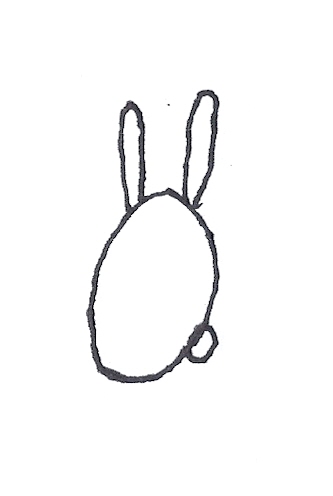
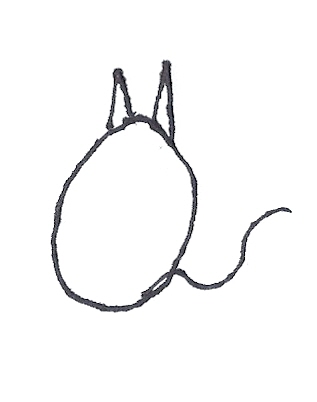
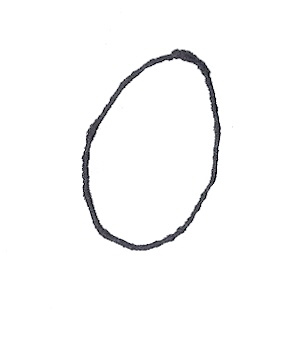
Sometimes it is difficult for symbols to convey the intended meaning because they are incomplete – they lack sufficient detail to accurately convey their meaning. For example:

scan0001

This symbol has some meaning – it is an oval – but if the intent is communicate either of the following examples this first symbol is not complete enough to communicate its intended meaning.

scan0002

scan0003

Without the added details it is not possible for the symbol to communicate its intended meaning.

Again – turning to the words of Langer:

“Music, on the other hand, is preeminently non-representative even in its classical productions, its highest attainments.  It exhibits pure form not as an embellishment, but as its very essence; we can take it in its flower – for instance, German music from Bach to Beethoven – and have practically nothing but tonal structures before us; no scene, no object, no fact.  That is a great aid to our chosen preoccupation with form.  There is no obvious, literal content in our way.  If the meaning of art belongs to the sensuous percept itself apart from what it ostensibly represents, then such purely artistic meaning should be most accessible through musical works.

This is not to say that music is the highest, the most expressive, or the most universal art.  Sound is the easiest medium to use in a purely artistic way; but to work in the safest medium is not at all the same thing as to achieve the highest aim.” (209)

In the next post we will begin to consider how consonance and dissonance impact our understanding of our composed or arranged musical symbols.

* Langer, Susanne K.  Philosophy in a New Key: A Study in the Symbolism of Reason, Rite, and Art.  Third editiion.  Cambridge:  Harvard University Press, 1957.