Several times in my writing I have referenced Philosophy in a New Key: A Study in the Symbolism of Reason, Rite, and Art by Susanne K. Langer*. Today I return to her writing as we continue our quest to understand how music communicates with our human brain.
“Meaning has both a logical and a psychological aspect. Psychologically, any item that is to have meaning must be employed as a sign or symbol; that is to say, it must be a sign or a symbol to someone. Logically, it must be capable of conveying a meaning, it must be the sort of item that can be thus employed. In some meaning-relations this logical requirement is trivial, and tacitly accepted; in others it is of the utmost importance, and may even lead us a merry a chase through the labyrinths of nonsense. These two aspects, the logical and the psychological, are thorougly confounded by the ambiguous verb ‘to mean’; for sometimes it is praper to say ‘it means,’ and sometimes ‘I mean.’ Obviously, a word – say, ‘London’ – does not ‘mean’ a city in just the same sense that a peerson employing the word ‘means’ the place.” (53)
A number of years ago I borrowed the following teaching from the work of Langer.
Sometimes it is difficult for symbols to convey the intended meaning because they are incomplete – they lack sufficient detail to accurately convey their meaning. For example:
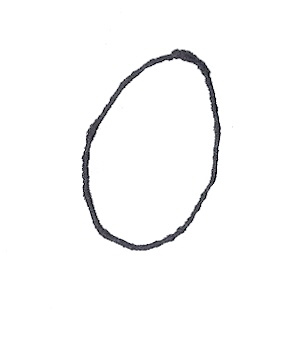
This symbol has some meaning – it is an oval – but if the intent is communicate either of the following examples this first symbol is not complete enough to communicate its intended meaning.
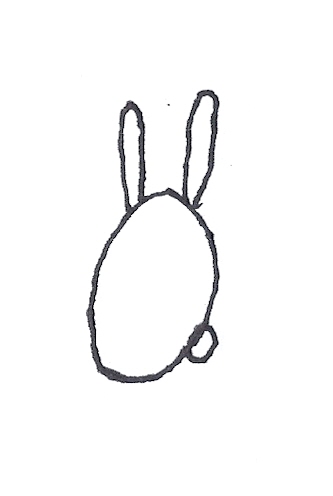
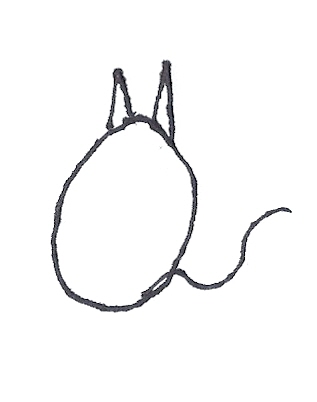
Without the added details it is not possible for the symbol to communicate its intended meaning.
Again – turning to the words of Langer:
“Music, on the other hand, is preeminently non-representative even in its classical productions, its highest attainments. It exhibits pure form not as an embellishment, but as its very essence; we can take it in its flower – for instance, German music from Bach to Beethoven – and have practically nothing but tonal structures before us; no scene, no object, no fact. That is a great aid to our chosen preoccupation with form. There is no obvious, literal content in our way. If the meaning of art belongs to the sensuous percept itself apart from what it ostensibly represents, then such purely artistic meaning should be most accessible through musical works.
This is not to say that music is the highest, the most expressive, or the most universal art. Sound is the easiest medium to use in a purely artistic way; but to work in the safest medium is not at all the same thing as to achieve the highest aim.” (209)
In the next post we will begin to consider how consonance and dissonance impact our understanding of our composed or arranged musical symbols.
* Langer, Susanne K. Philosophy in a New Key: A Study in the Symbolism of Reason, Rite, and Art. Third editiion. Cambridge: Harvard University Press, 1957.
 tmitchellmusic