Continuing from The Art of Possibility:
“If you have never played this game before, you will most likely find yourself struggling to solve the puzzle inside the space of the dots, as though the outer dots constituted the outer limit of the puzzle. The puzzle illustrates a universal phenomenon of the human mind, the necessity to sort data into categories in order to perceive it. Your brain instantly cliassifies the nine dots as a two-dimensional square. And there they rest, like nails in the coffin of any further possibility, establishing a box with a dot in each of the four corners, even though no box in fact exists on the page.
Nearly everybody adds that context to the instructions, nearly everybody hears; ‘Connect the dots with four straight lines without taking pen from paper, within the square formed by the outer dots.’ And within that framework there is no solution. If, however, we were to amend the original set of instructions by adding the phrase, ‘Feel free to use the whole sheet of paper,’ it is likely that a new possibility would suddenly appear to you.
It might seem that the space outside the dots was crying out, ‘Hey, bring some lines out here!‘
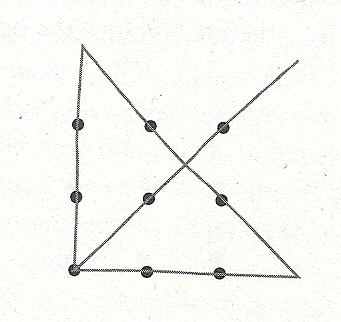
The frames our minds create define – and confine – what we perceive to be possible. Every problem, every dilemma, every dead end we find ourselves facing in life, only appears unsolvable inside a particular frame or point of view. Enlarge the box, or create another frame around the data, and problems vanish, while new opportunities appear.” (13-14)
Zander, Rosamund Stone and Benjamin Zander. The Art of Possibility: Transforming Professional and Personal Life. New York: Penguin Books, 2000.
 tmitchellmusic