From the pen of Frederick Buechner . . .

One of my favorite pieces of writing by Frederick Buechner is the one on “Art” from Whistling in the Dark: An ABC Theologized. Buechner’s words came to my mind as I was searching for just the right words to post in light of our recent discussions about music and frames while remembering that this is also the weekend of Easter.

Buechner writes:

“‘An old silent pond. / Into the pond a frog jumps. / Splash! Silence again.’ It is perhaps the best known of all Japanese haiku. No subject could be more humdrum. No langage could be more pedestrian. Basho, the poet, makes no comment on what he is describing. He implies no meaning, message, or metaphor. He simply invites our attention to no more and no less than just this: the old pond in its watery stillness, the kerplunk of the frog, the gradual return to the stillness.

In effect he is putting a frame around the moment, and what the frame does is enable us to see not just something about the moment but the moment itself in all its ineffable ordinariness and particularity. The chances are that if we had been passing by when the frog jumped, we wouldn’t have noticed a thing or, noticing it, wouldn’t have given it a second thought. But the frame sets it off from everything else that distracts us. It makes possible a second thought. That is the nature and purpose of frames. The frame does not change the moment, but it changes our way of perceiving the moment. It makes us NOTICE the moment, and that is what Basho wants above all else. It is what literature in general wants above all else too.

From the simplest lyric to the most complex novel and densest drama, literature is asking us to pay attention. Pay attention to the frog. Pay attention to the west wind. Pay attention to the boy on the raft, the lady in the tower, the old man on the train. In sum, pay attention to the world and all that dwells therein and thereby learn at last to pay attention to yourself and all that dwells therein.

The painter does the same thing, of course. Rembrandt puts a frame around an old woman’s face. It is seamed with wrinkles. The upper lip is sunken in, the skin waxy and pale. It is not a remarkable face. You would not look twice at the old woman if you found her sitting across the aisle from you on a bus. But it is a face so remarkably seen that it forces you to see it remarkably just as Cezanne makes you see a bowl of apples or Andrew Wyeth a muslin curtain blowing in at an open window. It is a face unlike any other face in all the world. All the faces in the world are in this one old face.

Unlike painters, who work with space, musicians work with time, with note following note as second follows second. Listen! says Vivaldi, Brahms, Stravinsky. Listen to this time that I have framed betweent the first note and the last and to these sounds in time. Listen to the way the silence is broken into uneven lengths between the sounds and to the silences themselves. Listen to the scrape of bow against gut, the rap of stick against drumhead, the rush of breath through reed and wood. The sounds of the earth are like music, the old song goes, and the sounds of music are also like the sounds of the earth, which is of course where music comes from. Listen to the voices outside the window, the rumble of the furnace, the creak of your chair, the water running in the kitchen sink. Learn to listen to the music of your own lengths of time, your own silences.

Literature, painting, music – the most basic lesson that all art teaches us is to stop, look, and listen to life on this planet, including our own lives, as a vastly richer, deeper, more mysterious business than most of the time it ever occurs to us to suspect as we bumble along from day to day on automatic pilot. In a world that for the most part steers clear of the whole idea of holiness, art is one of the few places left where we can speak to each other of holy things.

Is it too much to say that Stop, Look, and Listen is also the most basic lesson that the Judeo-Christian tradition teaches us? Listen to history is the cry of the ancient prophets of Israel. Listen to social injustice, says Amos; to head-in-the-sand religiosity, says Jeremiah; to international treacheries and power-plays, says Isaiah, because it is precisely through them that God speaks [God’s] word of judgment and command.

And when Jesus comes along saying that the greatest command of all is to love God and to love our neighbor, he too is asking us to pay attention. If we are to love God, we must first stop, look, and listen for [God] in what is happening around us and inside us. If we are to love our neighbors, before doing anything else we must see our neighbors. With our imagination as well as our eyes, that is to say like artists, we must see not just their faces but the life behind and within their faces. Here it is love that is the frame we see them in.

In a letter to a friend Emily Dickinson wrote that ‘Consider the lillies of the field’ was the only commandment she never broke. She could have done a lot worse. Consider the lillies. It is the sine qua non of art and religion both.” (14-16)

Buechner, Frederick. Whistling in the Dark: An ABC Theologized. San Francisco: Harper & Row, Publishers, 1988.
Song of the Man on the Road . . .

During the years I served as Director of Music for Memorial Drive Presbyterian Church in Houston, Texas I was blessed to partner with a number of gifted lyric writers. One of those people was The Reverend Fred McKirachan who provided the thought provoking lyrics for “Song of the Man on the Road” – which became an anthem composed for the high school choir at Memorial Drive. Those lyrics seem to provide a fitting post for this Good Friday. With deep gratitude to Fred McKirachan.

I met a man on the road to Jerusalem, his face set straight ahead. Eyes deep burning with a strange hot light, and I wondered with what passion it was fed. He spoke with a voice soft and gentle, yet all who were around him seemed to hear the echo of the ages in the words he spoke, and for each he stirred a vision bright and clear.

I have come to give you truth, and grace, and healing, from sin and fear and death to set you free. To show a style of living based on joy, thanks, and giving, and to help all people be who they can be.

One more time I saw the man nailed to a cross on a hill. His eyes turned to heaven with a strange hot light and the people all around were listening still.

I have come to give you truth, and grace, and healing, from sin and fear and death to set you free. To show a style of living based on joy, thanks, and giving, and to help all people be who they can be – who they can be.

The nine-dot puzzle – part two . . .

Continuing from The Art of Possibility:

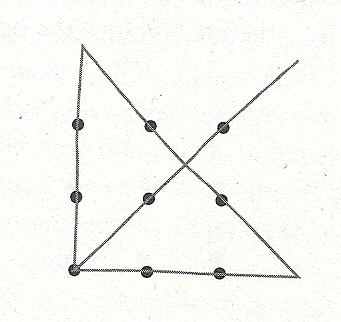
“If you have never played this game before, you will most likely find yourself struggling to solve the puzzle inside the space of the dots, as though the outer dots constituted the outer limit of the puzzle. The puzzle illustrates a universal phenomenon of the human mind, the necessity to sort data into categories in order to perceive it. Your brain instantly cliassifies the nine dots as a two-dimensional square. And there they rest, like nails in the coffin of any further possibility, establishing a box with a dot in each of the four corners, even though no box in fact exists on the page.

Nearly everybody adds that context to the instructions, nearly everybody hears; ‘Connect the dots with four straight lines without taking pen from paper, within the square formed by the outer dots.’ And within that framework there is no solution. If, however, we were to amend the original set of instructions by adding the phrase, ‘Feel free to use the whole sheet of paper,’ it is likely that a new possibility would suddenly appear to you.

It might seem that the space outside the dots was crying out, ‘Hey, bring some lines out here!

scan0002

The frames our minds create define – and confine – what we perceive to be possible. Every problem, every dilemma, every dead end we find ourselves facing in life, only appears unsolvable inside a particular frame or point of view. Enlarge the box, or create another frame around the data, and problems vanish, while new opportunities appear.” (13-14)

Zander, Rosamund Stone and Benjamin Zander. The Art of Possibility: Transforming Professional and Personal Life. New York: Penguin Books, 2000.

Maps, frameworks, and paradigms . . .

When I resumed this blog on March 12, 2013 I mentioned a book that had recently been given to me as a gift. I also stated how often I had observed that it was the “best book that I have ever read!” That book is The Art of Possibility: Transforming Professional and Personal Life by Rosamund Stone Zander and Benjamin Zander. As we continue our considerations about music I need to return to this wonderful volume. At first this may seem like a detour away from our current subject matter, but I plan to draw some direct links to our future considerations about music.

With deep gratitude the following is from one of the beginning chapters of The Art of Possibility:

“Most people already understand that, as with cultural differences, interpretations of the world vary from individual to individual and from group to group. This understanding may persuade us that by factoring out our own interpretations of reality, we can reach a solid truth. However, the term it’s all invented points to a more fundamental notion – that no matter how objective we try to be, it is still through the structure of the brain that we perceive the world. So, if there are absolutes, we have no direct access to their existence. The mind constructs. The meanings our minds construct may be widely shared and sustaining for us, but they may have little to do with the world itself. Furthermore, how would we know?

Even science – which is often too simply described as an orderly process of accumulating knowledge based on previously acquired truths – even science relies on our capacity to adapt to new facts by radically shifting the theoretical constructions we previously accepted as truth. When we lived in a Newtonian world, we saw straight lines and forces, in an Einsteinian universe, we noticed curved space/time, relativity, and indeterminancy. The Newtonian view is still valid – only now we see it as a special case, valid within a particular set of conditiions. Each new paradigm gives us the opportunity to see phenomena that were before as invisible to us as the colors of the sunset to the frog.

To gain greater insight into what we mean by a map, a framework, or a paradigm, let’s revisit the famous nine-dot puzzle, which will be familiar to many readers. As you may or may not know, the puzzle asks us to join all nine dots with four straight lines, without taking pen from paper. If you have never seen this puzzle before, go ahead and try it . . .” (12-13)

scan0001

More to follow in the next post!

Learning to listen . . .

People often ask, “How do you learn to hear the unique characteristics among different ways of organizing musical sounds?”  This post is going to suggest an introductory way to begin that process.

First a few general comments:

1.  The piano keyboard is organized into white notes and black notes.  Notice that the black notes are grouped in sets of twos and threes.  The white key immediately to the left (or below) any group of two black keys is a “C” – the pitches of the white keys then follow in sequence to the right (going up) – “D” – “E” – “F” – “G” – “A” – “B” – “C” – immediately to the left (or below) the next group of two black keys.  “Middle C” is the “C” in the middle of the keyboard.

2.  Scales – and modes – are organized into different groupings of “half steps” and “whole steps” – it is one half step from any note to the note closest to it – up or down.  Using “C” as a point of reference – from “C” down to “B” is one half step (both notes are white) – from “C” up to “C-sharp” is also one half step – “C-sharp” is the black key immediately to the right (or above) “C”.  Two consecutive half steps equal one whole step – “C” up to “D” or “C” down to “B-flat” (the black key immediately to the left (or below) “B”.

For this listening exercise you will only use the white keys.

First play the consecutive white notes to the right (going up) from “C” to the next “C” then play back down.  This is the “major scale” and is also known as the Ionian mode.

Next play the consecutive white notes to the right (going up) from “A” to the next “A” then play back down.  This is the “natural minor scale” and is also known as the Aeolian mode.  A lot of music in minor tonality is actually composed in “harmonic minor” which has a raised 7th note – so it includes “G-sharp” rather than “G”.

Much of our Western music is organized by using the “major” tonality or Ionian mode or “minor” tonality or Aeolian mode.

However, there are five other modes each with their own distinct sound.  These include (again using only the white notes)

Dorian mode – from “D” to “D”

Phrygian mode – from “E” to “E”

Lydian mode – from “F” to “F”

Myxolydian mode – from “G” to “G”

Locrian mode – from “B” to “B”

Each of the seven modes have a unique and distinct character that results from the arrangement of half steps and whole steps.  Play each mode several times and listen for the differences of character that each produces.

In the next post I will begin a discussion of harmony and follow with one about rhythm.  In the meantime you might want to compose some simple melodies in one of the modes listed above – I suggest that you start and end your melody on the first note of the mode or scale.

And just for fun – note that the tune for Greensleeves is in the Dorian mode.

The healing power of music . . .

For the next several posts I want us to consider the healing power of music. Music therapy has been used for years in a number of different situations, and we will focus on music therapy in a post that is part of this series.

Today, however, I want to call your attention to the musical journey. I first learned of the musical journey during a seminary class and a following internship with Austin Recovery here in Austin, Texas. My participation in musical journey, and my subsequent study of it, leads me to wish that it might be included in the training of anyone involved in the healing arts – both physical and spiritual.

Following is a description of the musical journey as it is found on the website for Austin Recovery (http://www.austinrecovery.org).

Musical journey is an experience-based therapy modified from Integrative Breathwork made popular by Jacquelyn Small. The journey consists of an hour of evocative music without words facilitated by cyclic breathing designed to put the participant in a meditative state of consciousness. The breathing combined with the musical pattern is designed to invoke emotions often blocked by more cognitive or protective processes of the brain. Musical journey allows repressed emotions and memories to surface and be felt, rather than simply being discussed. This expression is most often described as cathartic and speeds the healing process, often dramatically.

Oftentimes, addicts and alcoholics have spent much of their lives using to keep a particular memory or set of events out of their consciousness. By being able to bring these memories up, experience them and release them, many of our clients find a clearer path to recovery.

After each musical journey, clients go directly to art tables to draw mandalas depicting their hour-long experience. Mandalas are traditionally Indian and are seen to be a snapshot of the soul. You will see the result of some of these musical journeys in the mandalas included in the artwork of this website, as well as in the mandala gallery.

Music has the power to reach into the innermost part of a life and help transform it.

Music or noise . . .

Today we begin to look into the complex world of Hermann Helmholtz – mentioned in an earlier post. Following is the opening of his book On the Sensations of Tone*:

“Sensations result from the action of an external stimulus on the sensitive apparatus of our nerves. Sensations differ in kind, partly with the organ of sense excited, and partly with the nature of the stimulus employed. Each organ of sense produces peculiar sensations, which cannot be excited by means of any other; the eye gives sensations of light, the ear sensations of sound, the skin sensations of touch. Even when the same sunbeams which excite in the eye sensations of light, impinge on the skin and excite its nerves, they are felt only as heat, not as light. In the same way the vibration of elastic bodies heard by the ear, can also be felt by the skin, but in that case produce only a whirring fluttering sensation, not sound. The sensation of sound is therefore a species of reaction against external stiumulus, peculiar to the ear, and excitable in no other organ of the body, and is completely distinct from the sensation of any other sense.

As our problem is to study the laws of the sensation of hearing, our first business will be to examine how many kinds of sensation the ear can generate, and what differences in the external means of excitement or sound, correspond to these differences of sensation.

The first and principal difference between various sounds expeienced by our ear, is that between noises and musical tones. The soughing, howling, and whistling of the wind, the splashing of water, the rolling and rumbling of carriages, are examples of the first kind, and the tones of all musical instruments of the second. Noises and musical tones may certainly intermingle in very various degrees, and pass insensibly into one another, but their extremes are widely separated.

The nature of the difference between musical tones and noises, can generally be determined by attentive aural observation without artificial assistance. We perceive that generally, a noise is accompanied by a rapid alternation of different kinds of sensations of sound. Think, for example, of the rattling of a carriage over granite paving stones, the splashing or seething of a waterfall or of the waves of the sea, the rustling of leaves in a wood. In all these cases we have rapid, irregular, but distinctly peceptible alternations of various kinds of sounds, which crop up fitfully. When the wind howls the alternation is slow, the sound slowly and gradually rises and then falls again. It is also more or less possible to separate restlessly alternating sounds in case of the greater number of other noises. We shall hereafter become acquainted with an instrument, called a resonator, which will materially assist the ear in making this separation. On the other hand, a musical tone strikes the ear as a perfectly undisturbed, uniform sound which remains unaltered as long as it exists, and it presents no alternation of various kinds of constituents. To this then corresponds a simple, regular kind of sensation, whereas in a noise many various sensations of musical tones are irregularly mixed up and as it were tumbled about in confusion. We can easily compound noises out of musical tones, as, for example, by simultaneously striking all the keys contained in one or two octaves of a pianoforte. This shows us that musical tones are the simpler and more regular elements of the sensation of hearing.” (7-8)

And that is just the opening four paragraphs. The work of Helmholtz is clearly substantial and complex.

* Helmholtz, Hermann L. F. On the Sensations of Tone as a Physiological Basis for the Theory of Music. Translated by Alexander J. Ellis. New York: Dover Publications, Inc., 1954.

Colors and Music

Earlier today I posted a blog “Affectations and emotional characteristics of certain keys in music”.  Very soon after that I had a response from a visual artist friend – so – I am preparing another post for today that links colors with music.

First a bit of material from a website that is no longer working, but I want to credit the source anyway.

From http://www.composersdatebook.org/archives/090400.shtml
(this link no longer works 05/28/09)

Two Russian composers were fascinated with the idea of linking certain musical
keys to particular colors – but came up with completely different associations.
According to Nikolai Rimsky-Korsakov, the key of C Major was “white,”
while Alexander Scriabin said it was “red.” The two composers did
agree, however, that the key of D major was “yellow” and that Eb
Major was either “bluish-grey” or “steely.”

Here’s a list of other key signatures, with Rimsky-Korsakov’s color choice
given first, then Scriabin’s color association:

G Major (Brownish-gold/Orange-rose)
A Major (Rosy/Green)
E Major (SapphireBlue/Bluish-white)
B Major (Dark Blue/Bluish-white)
F# Major (Grayish-green/Bright blue)
Db Major (Dusky/Violet)
Ab Major (Grayish-violet/Purple-violet)
E Major (Green/Red)

Following is a link to a site that offers a wealth of information about colors and music by Charles E. H. Lucy:  http://www.harmonics.com/lucy/lsd/colors.html.  I commend it to you for further study – and – I hope John will join our community of discussion.  I also encourage everyone to participate – the more the merrier!!

The next post will begin a series that focuses on the work of Hermann Ludwig Ferdinand Helmholtz (1821-1894).  His book On the Sensations of Tone is largely responsible for most of my interest in this complex area of study.  I just received a new copy of the work and I am anxious to renew my friendship with this old friend.  Following is from the back cover notes of the book:

On the Sensations of Tone is one of the world’s greatest scientifc classics.  It bridges the gap between the natural sciences and music theory and, nearly a century after its first publication, it is still a standard text for the study of physiological acoustics – the scientific basis of musical theory.  It is also a treasury of knowledge for musicans and students of music and a major work in the realm of aesthetics, making important contributions to physics, anatomy, and physiology in its establishiment of the physical theory of music.”

The book is currently available from Dover Publications, Inc., New York.

Until next time . . .

Affectations and emotional characteristics of certain keys in music . . .

Today I want to pass along some fascinating information that I have discovered during my study time in preparation for writing this series of posts on music. Following posts will delve into deeper discussion of these matters, but today I simply want to offer them for your reflection and response.

Many theoretical works of the eighteenth century explicitly assign certain affectations or emotional characteristics to different keys. Though these writings often contradict each other as to what these characteristics actually are, it is well known that many composers carefully chose keys for similar affectations throughout their lives. To Mattheson, for example, D major was “somewhat shrill and stubborn,” while to Rousseau it was suited to “gaiety or brilliance.”

From http://www2.hmc.edu/~alves/justkeys.html

Affective Key Characteristics in Music
from Christian Schubart’s Ideen zu einer Aesthetik der Tonkunst (1806)

C Major – Completely Pure. Its character is: innocence, simplicity, naivety, children’s talk.

C Minor – Declaration of love and at the same time the lament of unhappy love. All languishing, longing, sighing of the love-sick soul lies in this key.

Db Major – A leering key, degenerating into grief and rapture. It cannot laugh, but it can smile; it cannot howl, but it can at least grimace its crying.–Consequently only unusual characters and feelings can be brought out in this key.

C# Minor – Penitential lamentation, intimate conversation with God, the friend and help-meet of life; sighs of disappointed friendship and love lie in its radius.

D Major – The key of triumph, of Hallejuahs, of war-cries, of victory-rejoicing. Thus, the inviting symphonies, the marches, holiday songs and heaven-rejoicing choruses are set in this key.

D Minor – Melancholy womanliness, the spleen and humors brood.

Eb Major – The key of love, of devotion, of intimate conversation with God.

D# Minor – Feelings of the anxiety of the soul’s deepest distress, of brooding despair, of blackest depresssion, of the most gloomy condition of the soul. Every fear, every hesitation of the shuddering heart, breathes out of horrible D# minor. If ghosts could speak, their speech would approximate this key.

E Major – Noisy shouts of joy, laughing pleasure and not yet complete, full delight lies in E Major.

E minor – Naive, womanly innocent declaration of love, lament without grumbling; sighs accompanied by few tears; this key speaks of the imminent hope of resolving in the pure happiness of C major.

F Major – Complaisance and Calm.

F Minor – Deep depression, funereal lament, groans of misery and longing for the grave.

F# Major – Triumph over difficulty, free sigh of relief uttered when hurdles are surmounted; echo of a soul which has fiercely struggled and finally conquered lies in all uses of this key.

F# Minor – A gloomy key: it tugs at passion as a dog biting a dress. Resentment and discontent are its language.

G Major – Everything rustic, idyllic and lyrical, every calm and satisfied passion, every tender gratitude for true friendship and faithful love,–in a word every gentle and peaceful emotion of the heart is correctly expressed by this key.

G Minor – Discontent, uneasiness, worry about a failed scheme; bad-tempered gnashing of teeth; in a word: resentment and dislike.

Ab Major – Key of the grave. Death, grave, putrefaction, judgment, eternity lie in its radius.

Ab Minor – Grumbler, heart squeezed until it suffocates; wailing lament, difficult struggle; in a word, the color of this key is everything struggling with difficulty.

A Major – This key includes declarations of innocent love, satisfaction with one’s state of affairs; hope of seeing one’s beloved again when parting; youthful cheerfulness and trust in God.

A minor – Pious womanliness and tenderness of character.

Bb Major – Cheerful love, clear conscience, hope aspiration for a better world.

Bb minor – A quaint creature, often dressed in the garment of night. It is somewhat surly and very seldom takes on a pleasant countenance. Mocking God and the world; discontented with itself and with everything; preparation for suicide sounds in this key.

B Major – Strongly colored, announcing wild passions, composed from the most glaring colors. Anger, rage, jealousy, fury, despair and every burden of the heart lies in its sphere.

B Minor – This is as it were the key of patience, of calm awaiting one’s fate and of submission to divine dispensation.

Translated by Rita Steblin in A History of Key Characteristics in the 18th and Early 19th Centuries. UMI Research Press (1983).

From http://www.wmich.edu/mus-theo/courses/keys.html

As always your comments and thoughts are welcome and invited. I hope more of you will join in our community conversation.

We have NOT always done it that way . . .

One of my most memorable classes during my master’s degree study at the University of Illinois focused on a study of historic tuning systems in music. Those of us in the class often observed that we spent an entire semester learning how to “sing out of tune.” However, the truth was that we spent an entire semester learning to sing correctly in tuning systems that preceeded our modern day equal tempered tuning.

We began the semester by learning to sing in “just intonation” – the tuning that is based on the pure tuning of perfect intervals found in the harmonic overtone series. For most of us in the class we discovered why something that was common to our previous experience was true – for reasons of physics not just because our choral ensembles were less than perfect. We learned a composition that was familiar to everyone in the class – Adoramus Te by Giovanni Pierluigi da Palestrina (1525-1591) – and, as most of us had always done, we learned this famous short composition beginning with an “a minor” chord – and much to our surprise we discovered – that just like before we knew what we were doing – this famous motet ended one-half step lower than our beginning pitch even though the written last pitches are the same as the first. This was true even when we sang each and every pitch perfectly in tune using “just intonation” – or tuning based on the pure natural physics of the overtone series.

We were then taught – by our wise instructor – that prior to the invention of equal tempered tuning – the “circle of fifths” which most music students know well does not line up at the end with the pitch at the beginning – the place where the two pitches would be the same in “equal tempered tuning” are not the same in “just intonation” or other earlier tuning systems – the point of arrival at the end of the circle is, in fact, lower than the beginning. That is why all choirs who sing the Adoramus Te beginning in “a minor” conclude at a lower pitch than the one with which they started – even if their tuning is extradorinarily accurate.

Next we discovered that by beginning with a slightly higher or lower set of pitches the end of our effort matched the pitches with which we began our singing. Why? We avoided the chord progressions which lead to a lower pitch than where our groups of singers began.

I hear many of you saying: “SO WHAT?” The answer is “It’s complicated!” We will continue with this subject in coming posts – but for now – let it suffice that what we know as “in tune” in equal tempered tuning – the modern standard in which all half-steps seem to be the same distance apart so a person may play any song in any key – is actually ever so slightly out of tune according to the natural physics of sound.

Some of you are still saying: “SO WHAT?” This is also related to part of the explanation why some keys are referred to as “bright” sounding keys, while others are referred to as “darker” sounding keys. No they are not all the same.

More about this in coming posts – really, I do have a plan to get to a serious point about how music communicates with our brains. Also, in a coming post I will list a number of excellent sources that help explain all of this – some of them are actually in simple English – while others require some knowledge of physics. My goal is to find a way to explain this so that it makes some sense as we continue our journey of understanding of how music communicates with human beings.

In the mean time – keep on singing!!